

What if the strongest reason to buy isn’t a forecast of rising prices, but how well a property fits your life and plans? The benefits of buying property in the UAE can include an internationally connected lifestyle, ownership opportunities for foreign buyers in designated freehold areas, and the potential to earn rental income. None of these guarantees residency approval, a tenant, or capital growth.
It’s understandable to be drawn to property opportunities while wanting clear answers about ownership, costs, and risk. This guide explains the practical advantages and considerations that can shape your decision, from residency eligibility and purchase costs to the differences between ready and off-plan property.
You’ll come away with a grounded view of what ownership may offer, what it can’t promise, and which questions deserve attention before you commit. Terra Firma advises buyers on ready and off-plan residential, commercial, and retail acquisitions, helping align a property search with their objectives.
Key Takeaways
- The benefits of buying property in dubai depend on whether your priority is a home, a long-term investment, or a business asset.
- Understand the difference between owning eligible freehold property and qualifying for a UAE residency visa. One doesn’t automatically grant the other.
- Assess rental income, appreciation, and tax treatment as potential advantages, not guaranteed outcomes.
- Weigh the appeal of property ownership against practical considerations such as vacancy, maintenance, resale liquidity, and changing market conditions.
- Clarify your objectives before comparing ready, off-plan, commercial, and retail property options.
What makes buying property in Dubai appealing to different buyers?
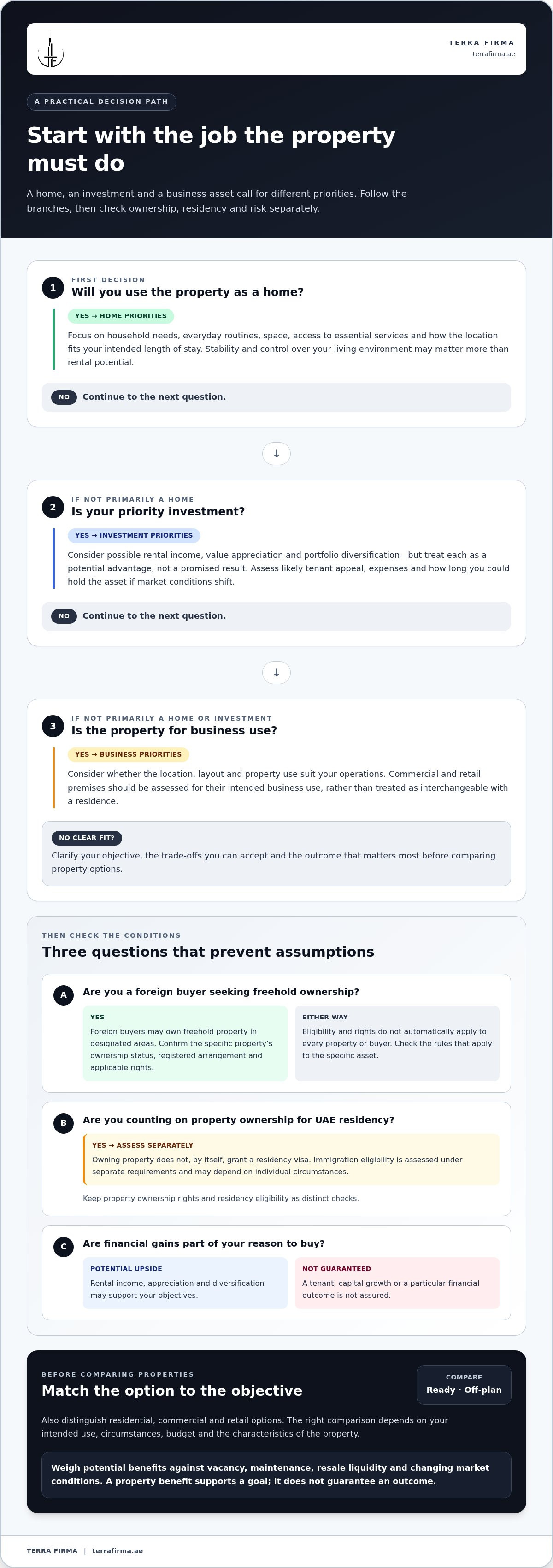
The appeal depends on the buyer. Homeowners may value a place to live, long-term investors may consider rental potential and portfolio diversification, while business buyers may seek premises suited to commercial or retail activity. The benefits of buying property in dubai are best assessed against a specific purpose, not treated as a universal promise of financial gain.
A property benefit is a potential advantage that supports a buyer’s goals, not a guaranteed outcome. In practical terms, buyers may weigh:
- Ownership: A long-term asset and, for foreign buyers, the possibility of freehold ownership in designated areas.
- Lifestyle: A home that fits preferred routines, household needs, and intended length of stay.
- Portfolio diversification: Property exposure alongside other asset types, with risks specific to the asset and market.
- Investment potential: Possible rental income or value appreciation, neither of which is assured.
The relevance of each advantage depends on your circumstances, budget, intended use, and the property’s characteristics. A home chosen for daily comfort may not suit a buyer focused on rental demand. A commercial or retail asset should be assessed for its intended business use, rather than treated as interchangeable with a residence.
Which buyer goals can property ownership serve?
Start by distinguishing personal use from investment or business use. For a primary residence, consider practical needs such as space, access to essential services, and suitability for everyday life. Stability and control over your living environment may matter more than rental potential.
An investment purchase calls for a different approach. Examine the property’s appeal to prospective tenants, expected expenses, and how long you could hold the asset if market conditions shift. Rental demand and future resale value can vary, so don’t infer either from headline features alone. For business buyers, the property’s location, layout, and suitability for operations may matter more than residential amenities.
No single property type serves every objective. Before comparing options, clarify how you plan to use the asset, which trade-offs you can accept, and what outcome matters most.
Why does Dubai attract international property interest?
An internationally connected lifestyle, business activity, and transport links can make property ownership relevant to buyers with personal, investment, or commercial interests. Infrastructure may support daily living, travel, and business operations. Its value depends on your needs: a frequent traveller may prioritise transport access, while a household may focus on everyday services and convenient routines.
For broader background on how the property sector has developed, see the Dubai Real Estate Market Overview. Market activity can signal interest, but it doesn’t establish what a particular property will earn or how its value will change. Evaluate the asset, intended use, and holding horizon on their own merits.
Before treating international appeal as a reason to buy, define what you need the property to do. That clarity makes it easier to compare lifestyle value with investment potential and identify which advantages are relevant to you.
How can ownership rights and lifestyle add value beyond investment?
Property can offer value that isn’t captured by rental income or resale prospects alone. For some buyers, that means a home that supports a preferred routine; for others, it means premises for business use. These benefits of buying property in dubai are personal and practical, but ownership rights and lifestyle advantages depend on the specific property and the buyer’s circumstances.
What does freehold ownership mean for eligible buyers?
Freehold ownership generally means owning the property itself, rather than holding only a time-limited right to use it. Foreign buyers can own freehold property in designated areas, but eligibility and rights don’t automatically apply to every property or buyer. The registered ownership arrangement and the rules in force matter.
Owning property and qualifying to live in the UAE are separate matters. Property ownership doesn’t, by itself, grant a residency visa. Immigration eligibility is assessed under separate requirements, which can change and may depend on individual circumstances. Before committing, review current Dubai Land Department guidance on property rights and registration, and consult relevant official UAE residency information for visa criteria.
Keep the distinction clear: review the property’s ownership status and applicable rights as part of your purchase assessment, then consider residency eligibility separately. General market statements don’t establish the legal position of a specific asset.
How can lifestyle and infrastructure influence a purchase?
Daily convenience can shape whether a property feels right long after the initial viewing. Access to transport, essential services, and amenities may matter differently to a household, a frequent traveller, or a business owner. Consider how those features fit your intended use, rather than assuming a prestigious address or extensive facilities will suit every buyer.
- For a home: Consider household routines, space needs, and access to the services you use regularly.
- For a second residence: Think about how often you expect to use it and whether the location and facilities suit those visits.
- For business use: Assess whether access, layout, and surrounding services support your operations and customer needs.
Lifestyle value is distinct from measurable investment performance. A convenient home may improve everyday comfort without increasing rental income; an asset with investment potential may not match your personal preferences. Treat these as separate considerations, then decide how much weight to give each.
Make the assessment concrete. List the features you’ll use, separate essentials from preferences, and consider how your needs may change over time. Those priorities can help focus a search across residential, commercial, or retail options. Terra Firma’s property acquisition guidance can help connect your objectives with a suitable property search.
Which financial and residency benefits are possible, and what is not guaranteed?
Financial and residency advantages can form part of a property decision, but neither should be treated as a promised result. Rental income depends on whether a property attracts tenants and how much it costs to hold. Appreciation varies with the asset and market cycle. Residency eligibility follows separate rules and an application process.
The benefits of buying property in dubai are best assessed by separating what may be possible from what depends on circumstances:
Potential advantage
What it may mean
What can affect the outcome
Rental income
A property may earn income when rented.
Tenant demand, occupancy, rent levels, and property-related expenses affect what remains.
Value appreciation
The asset may rise in value over time.
Market conditions, property characteristics, and holding period can influence resale value; prices can also fall.
Tax treatment
Dubai does not impose annual property tax, capital gains tax, or tax on residential rental income for individuals.
Other charges may apply, and a buyer’s tax position can depend on personal circumstances and obligations in their home country.
Residency eligibility
Property ownership may be relevant to an available residency pathway.
Current criteria, documentation, and approval decisions determine eligibility. Ownership alone does not grant residency.
What financial advantages might property ownership offer?
Rental income is a possibility, not a fixed yield. A home may be vacant between tenants, while service, maintenance, and other holding expenses can reduce net income. Assess likely demand for the specific property and allow for periods without rent instead of relying on headline estimates.
Appreciation is equally uncertain. A property’s resale value can respond to its condition, appeal, and wider market conditions. The holding period also affects how long there is for value to change. Don’t treat past performance or a market forecast as a guarantee of future results.
Can property ownership support residency eligibility?
Some UAE residency pathways may take property ownership into account, subject to the rules in force and the applicant’s circumstances. A property purchase is not an automatic visa, and an application does not guarantee approval. Requirements can change, so review current official UAE guidance before relying on a pathway in your plans.
Keep the financial and residency assessments distinct. A property that suits your investment objectives may not establish residency eligibility, and a potential visa route does not make an investment low-risk. Consider the asset, demand, occupancy, expenses, and market conditions together, then assess tax and residency implications for your circumstances before proceeding.
What risks and trade-offs should buyers weigh before choosing Dubai property?
Property can appeal to homeowners, investors, and businesses, but ownership isn’t risk-free. An asset may take time to resell, remain vacant between tenants, or require unplanned maintenance. Market conditions can change, too. A sound decision weighs these possibilities against the property’s intended use, rather than assuming demand, rental income, or prices will always rise.
Liquidity deserves particular attention. Property can be less straightforward to sell quickly than assets that trade more easily. If you may need access to your capital on a short timeline, consider whether you could hold the property through a slower resale period without disrupting other plans.
Which trade-offs can affect the ownership experience?
Plan for the ongoing realities of ownership as well as the purchase itself. A rental property may have gaps between tenants, and maintenance or other property-related expenses can reduce net income. A ready property is an existing asset you can assess, while an off-plan purchase involves waiting for completion and the possibility that timelines or market conditions differ from expectations.
- Resale timing: A suitable buyer may not appear when you want to sell, so avoid relying on an immediate exit.
- Vacancy and costs: Allow for periods without rental income and expenses that continue while the property is unoccupied.
- Market cycles: Values and tenant demand can rise or fall; past movement doesn’t establish what happens next.
- Purchase structure: Ready and off-plan properties differ in availability, timing, and what you can assess before buying.
These factors don’t make a purchase unsuitable by default. They help reveal whether the asset remains manageable if the outcome is less favourable than expected.
How can a buyer judge whether the benefits fit?
Use a practical fit test before narrowing your options. Be clear about the property’s purpose, how long you can hold it, and how much uncertainty you’re prepared to accept. Then compare those answers with the type of asset you’re considering.
- Personal use: Prioritise features that support your household and the way you expect to use the home.
- Rental income: Consider tenant demand, possible vacancies, and expenses, not just the rent you hope to receive.
- Business activity: Assess whether commercial or retail premises suit your operational needs and intended use.
- Liquidity needs: Consider whether you can keep the asset if selling takes longer than planned.
- Risk tolerance: Decide in advance how you would respond to lower demand, additional costs, or a market decline.
The benefits of buying property in dubai matter most when they fit your objectives and remain worthwhile under realistic scenarios. Terra Firma advises buyers across ready and off-plan residential, commercial, and retail acquisitions. Explore property acquisition guidance with Terra Firma to bring your priorities into a focused search.
How can Terra Firma help turn the benefits into an informed property search?
A clear property search begins with your objectives, not a list of available units. The benefits of buying property in dubai can mean different things to different buyers, so define what success looks like before comparing options. A home for personal use, a potential rental asset, and premises for business activity call for distinct priorities.
How does objective-led property search work?
Terra Firma helps buyers turn broad interest into a focused search by connecting their goals with relevant property categories and opportunities. Start with four considerations: intended use, investment horizon, tolerance for uncertainty, and preferred property type. These set the direction without assuming one category will suit every buyer.
- Clarify the purpose. Decide whether you’re seeking a primary residence, a property with rental potential, or premises for commercial or retail use.
- Set your time horizon. Consider how long you expect to hold the asset and whether you may need to access your capital sooner.
- Define your priorities. Identify essential features, acceptable trade-offs, and the level of uncertainty you can manage.
- Focus the search. Use those criteria to review relevant ready or off-plan residential, commercial, and retail opportunities.
This sequence keeps the search purposeful and makes comparisons more useful. Instead of weighing properties on headline appeal alone, consider how each aligns with your intended use, timeframe, and investment approach. Review purchase documents and transaction requirements as part of your due diligence before proceeding.
What can Terra Firma support during acquisition?
Terra Firma advises buyers across ready and off-plan residential property, as well as commercial and retail acquisitions. Ready options may suit buyers who want to assess an existing property, while off-plan opportunities can appeal to those considering a purchase before completion. The right route depends on your objectives, timing, and comfort with the relevant trade-offs.
For commercial and retail purchases, the intended activity can help shape what to prioritise, from the property category to its suitability for the planned use. Terra Firma provides transaction advisory from enquiry through transfer, helping buyers move from initial objectives toward a considered acquisition. This is purchase guidance, not a promise of investment returns, lending, or ongoing property management.
Bring your priorities into a more focused search. Explore property opportunities with Terra Firma across ready, off-plan, commercial, and retail categories.
Turn your priorities into a considered next step
Before moving from research to a shortlist, write a concise decision brief. Note the property’s intended use, essential features, acceptable trade-offs, and circumstances that would make you pause. This gives each opportunity a clear measure beyond first impressions. The benefits of buying property in dubai matter most when they align with that personal framework.
Use the brief to keep your search focused as new options arise. If a property looks appealing, compare it with your priorities and consider how it would serve your plans if circumstances or market conditions changed. A thoughtful process leaves room for ambition while helping you avoid decisions based on assumed returns or benefits that don’t fit your needs.
Terra Firma can translate your objectives into an acquisition search, with advice on ready and off-plan property, commercial and retail transaction support, and guidance from enquiry through transfer. Explore property opportunities with Terra Firma and take the next step with a clearer sense of what you’re looking for.
Frequently Asked Questions
Can a non-resident buy property in Dubai?
A non-resident may be able to buy property, depending on the applicable ownership rules and the specific property. Foreign buyers can own freehold property in designated areas, but that doesn’t mean every listing is open to every buyer or that a purchase grants permission to live in the UAE. Review the property’s status and current requirements through Dubai Land Department guidance before proceeding.
Does buying property in Dubai automatically qualify a buyer for residency?
No. Buying property doesn’t itself grant residency or guarantee visa approval. A purchase may be relevant to a qualifying pathway, but criteria, supporting documents, and decisions depend on current rules and your circumstances. Before building a relocation plan around a property, review the latest requirements published by relevant UAE government authorities and consider how they apply to your case. Treat ownership and immigration permission as separate decisions.
Can I complete a Dubai property purchase while living overseas?
Some steps in a property purchase may be completed from overseas, but don’t assume the entire transaction can be handled remotely. The process may depend on the transaction structure, identity verification, and whether the required documents are accepted in your circumstances. Before committing, map out which actions require your presence or formal authorisation, and seek qualified legal guidance if documentation or representation arrangements are unclear.
How much rental income can a Dubai property generate?
There’s no universal rental-income figure or guaranteed yield. Results depend on the individual asset, its condition and type, tenant demand, occupancy, expenses, and the market cycle. For a realistic assessment, compare current evidence for similar properties and estimate income after expected costs and vacant periods. The benefits of buying property in dubai shouldn’t be judged on headline rent alone.
What happens if an off-plan project is delayed?
A delay doesn’t automatically lead to one standard remedy. Available options may depend on the purchase agreement, the reason for delay, project circumstances, and rules currently in force. Before signing, understand the contractual completion milestones, notice provisions, and applicable protections. If a project is delayed, review the agreement and seek qualified legal advice on your specific position rather than assuming a refund, compensation, or revised handover date.
Can two people buy a property in Dubai jointly?
Yes, joint ownership may be possible, but registration, recorded ownership shares, and required documents depend on the buyers and transaction. Co-buyers should agree in advance how costs and responsibilities will be handled, how decisions are made, and what happens if one person wants to sell or exit. Put arrangements in writing and obtain appropriate professional guidance, since legal and tax implications can vary.


