

What if the right property isn’t the most prominent listing, but the one that fits your plans? If you’re considering whether to buy real estate in dubai, start with your purpose. A home, a commercial asset and a retail space call for different property criteria and may follow different purchase routes.
Having plenty of options doesn’t always make the decision easier. Ready and off-plan properties involve different considerations, and a purchase can include documentation, negotiation, transfer coordination and costs to plan for. A clear process helps you compare options without relying on pressure or promises of guaranteed returns.
This guide will help you define your priorities, assess residential, commercial and retail properties, and compare ready and off-plan purchases. It also outlines key transaction stages and the professional support that can help keep each step organised. Terra Firma’s advisors support buyers from property enquiry through negotiation and transfer coordination, helping you approach the decision with greater clarity.
Key Takeaways
- Set your purpose first: a home, business premises and an investment each call for different priorities.
- Compare residential, commercial and retail options by intended use, then weigh the practical differences between ready and off-plan purchases.
- Look beyond listing details by assessing the property, ownership documents, payment terms and contract before committing.
- Follow a deliberate purchase path from defining your brief to shortlisting, assessment, negotiation, review and transfer coordination.
- To buy real estate in dubai with greater clarity, match your priorities to relevant options and understand how transaction support can guide each milestone.
Buying real estate in the UAE: start with your reason for purchasing
A major property purchase can feel complex when listings offer more choice than clarity. Before comparing features or arranging viewings, decide what the property needs to do for you. A home for personal use may call for a different layout and timeline from premises for a business or an asset held for investment. If you plan to buy real estate in dubai, start with that distinction rather than letting available listings set your priorities.
Your intended use is only one part of the brief. Consider how long you expect to hold the property and how involved you want to be in decisions about its use. A buyer seeking a place to live may prioritise everyday function and timing. A business occupier may focus on operational suitability, while an investor may consider their own time horizon and risk tolerance without assuming a particular financial outcome. The Economy of Dubai offers background on the emirate’s economic landscape.
A buyer brief turns your priorities into practical criteria, making it easier to assess each option against what matters to you.
Clarify what the property needs to do for you
Write down whether you’re buying for personal use, business occupation or investment. Then rank the priorities that will help you compare properties, such as layout, permitted use, handover or move-in timing, and the level of involvement you want after purchase.
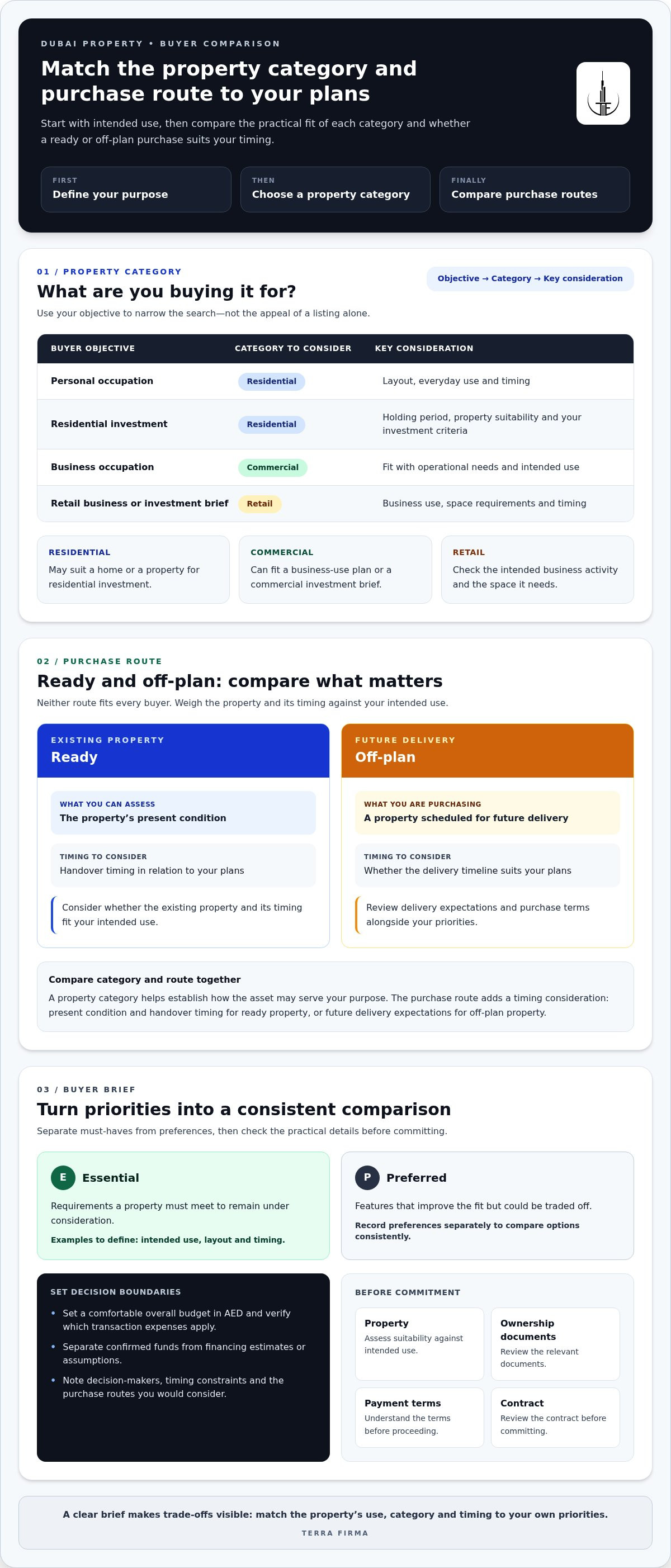
- Essential: Requirements a property must meet to remain under consideration.
- Preferred: Features that would improve the fit but could be traded off.
This distinction makes shortlisting more disciplined. A spacious layout might be essential for one household but only a preference for another buyer. Recording the difference helps you compare properties consistently instead of being swayed by presentation alone.
Set decision boundaries before browsing listings
Set a comfortable overall budget in AED, allowing room for transaction expenses once you have verified what applies to the purchase. If you expect to use financing, separate confirmed funds from estimates or assumptions. This prevents an indicative figure from being mistaken for money you can rely on.
- Name everyone involved in the decision and agree how choices will be made.
- Note timing constraints, such as a target move-in or business occupancy date.
- Record which purchase routes you would consider, including ready or off-plan property.
These boundaries keep the search focused and make trade-offs visible early. A clear brief is not a commitment to buy. It is a practical starting point for comparing suitable options with greater confidence.
Choose the right real estate category for your intended use
Once your priorities are clear, narrow the search by property category and purchase route. A residential home, commercial unit and retail premises serve different purposes, even when each looks appealing in a listing. The right fit depends on how you plan to use the property, when you need it and whether you prefer an existing asset or one scheduled for future delivery.
Buyer objective
Category to consider
Key consideration
Personal occupation
Residential
Layout, everyday use and timing
Residential investment
Residential
Holding period, property suitability and your investment criteria
Business occupation
Commercial
Fit with operational needs and intended use
Retail business or investment brief
Retail
Business use, space requirements and timing
Residential, commercial, or retail: which use fits?
Residential property may suit someone seeking a home or a property for residential investment. Commercial units can fit a business-use plan or a commercial investment brief. Retail premises require close attention to the intended business activity and the space it needs. These categories are a starting point, not a verdict: assess each property against your intended use, priorities and time horizon.
For a business purchase, turn practical needs into criteria before comparing units. Consider how the space must function and whether its configuration suits the intended activity. Retail buyers should also specify their space requirements rather than treating every unit as interchangeable. This helps distinguish a genuine fit from an appealing listing that may not serve the intended purpose.
Ready or off-plan: compare the purchase route
A ready property already exists, so you can assess its present condition and consider handover timing in relation to your plans. An off-plan purchase is for a property scheduled for future delivery, making the delivery timeline central to whether that route suits you. Neither option is right for every buyer. Let your intended use, timing and comfort with the purchase structure guide the comparison.
Start with this distinction, then examine the detailed trade-offs before choosing a route. Review delivery expectations and purchase terms alongside your priorities. If you plan to buy real estate in dubai, comparing the property category and purchase route together can help prevent a mismatch between what you want the property to do and when it can serve that purpose.
With your criteria in place, a tailored shortlist can focus on relevant residential, commercial or retail options, including ready and off-plan properties. Explore property options with Terra Firma to bring your intended use and preferred purchase route into the search.
Assess the property and transaction before making a commitment
An elegant listing can make a property feel like an obvious choice, but it cannot establish condition, ownership, suitability or value on its own. Before you decide to buy real estate in dubai, assess the property and the transaction terms separately. A careful review can surface questions while there is still time to address them.
Keep four checks distinct: the physical property, ownership and supporting records, the payment plan, and the contract. Each answers a different question. A well-presented unit may still need a closer condition review, and a payment schedule may look manageable until you account for other charges and timing.
Review the property information and supporting documents
Compare the listing with available property information and ownership documents. Resolve differences in stated size, layout, permitted use or included features before relying on them. For a ready property, assess its condition and clarify what will be handed over and when. Check that the space and its stated use fit your plans for personal occupation or business.
For an off-plan purchase, review the project’s current status alongside the written project information. Examine the stated delivery arrangements, payment milestones and escrow details. Treat the handover date and payment terms as matters to understand from the project documents, not assumptions based on promotional descriptions. Legal, registration and regulatory requirements can change, so verify current details for the specific transaction.
Test the financial assumptions without relying on promises
Start with the purchase price, then make a separate estimate of transaction expenses and ongoing ownership obligations. Transfer and registration-related fees, along with other possible charges, may apply. The amounts and arrangements depend on the purchase, so verify the costs relevant to your transaction before committing.
- Payment: Map each instalment or payment milestone against its due date and your confirmed funds. Keep estimates distinct from financing that is actually in place.
- Ownership costs: Allow for applicable transaction charges and recurring obligations, such as maintenance-related costs, without assuming they are the same for every property.
- Use and timing: Test affordability against realistic occupancy or delivery timing, including any period before the property can serve its intended purpose.
- Investment assumptions: Treat potential income and appreciation as uncertain scenarios, not promised outcomes. Consider whether the purchase still fits your plan if those assumptions change.
Read the contractual terms as a separate part of your review. Check that the agreed property details, payment commitments, delivery or handover terms, and responsibilities match your understanding of the purchase. Resolve unclear or inconsistent wording before proceeding. Attractive presentation can start the conversation, but documented condition, clear terms and realistic financial assumptions should inform your decision.
Move from shortlist to purchase with a clear transaction plan
A purchase is easier to manage when each decision has a place in the sequence. If you plan to buy real estate in dubai, move from a defined brief to a considered shortlist, then assess, negotiate, review and coordinate the transfer. Documents and steps can vary by property and transaction, so verify the current requirements for your purchase before proceeding.
- Define the brief. Record intended use, essential criteria, timing and budget boundaries. This gives everyone involved a consistent basis for evaluating options.
- Build the shortlist. Apply those criteria across relevant residential, commercial or retail properties. Include ready or off-plan options only when the route fits your plans.
- View or assess. Compare each property with your brief, review the available information and note questions that need answers before you progress.
- Negotiate. Clarify the proposed price, timing and other terms with the seller. Separate agreed points from open ones before treating the discussion as settled.
- Review. Read the transaction documents, payment arrangements and relevant property information together. Make sure the written terms reflect your understanding of the proposed purchase.
- Coordinate transfer. Once the parties are ready to proceed, organise the remaining transaction steps and required documentation according to the current process for that purchase.
Turn priorities into a focused property shortlist
Use essential requirements as filters rather than browsing without direction. Compare shortlisted properties against the same criteria, such as intended use, layout, delivery status and timing, instead of relying on photographs or listing language alone. Before a viewing or further assessment, note what you need to establish, what would rule out the property and which trade-offs you could accept.
Coordinate negotiation, review, and transfer
Negotiation turns initial interest into proposed terms. Keep a clear record of what the buyer and seller have discussed, then review the documentation and payment arrangements before moving toward completion. Terra Firma’s advisors support buyers from enquiry and negotiation through transfer coordination, helping keep the purchase steps aligned as the transaction progresses.
Document requirements and procedures can depend on the purchase route and property. For detailed preparation, consult dedicated purchase-document and transaction-preparation guides alongside current authoritative guidance. Resolve outstanding questions before committing to the next milestone. A careful pause can be more valuable than proceeding on an assumption.
For a purchase plan shaped around your priorities, explore property options with Terra Firma and get support through the transaction journey.
Buy real estate with Terra Firma’s transaction advisory
Property discovery is only the beginning. To buy real estate in dubai with greater clarity, connect your intended use with the right category, purchase route and next steps. Terra Firma supports acquisitions across ready and off-plan properties, as well as commercial and retail spaces. The focus is finding a considered fit, not promising financial performance.
Advisory follows a clear sequence: understand your priorities, identify relevant options, support negotiation and coordinate the transaction. This keeps the conversation anchored to your objectives as the purchase moves from enquiry toward transfer.
What a tailored acquisition conversation covers
Start with a concise outline of what you want the property to do. Share your intended use, preferred category, timing and most important priorities. You might be seeking a home for personal occupation, premises for a business, retail space, or a property that fits an investment brief. Clarity at this stage gives the search a useful direction.
Advisors use those details to focus the property search on relevant ready or off-plan options across residential, commercial and retail categories. As options emerge, clear communication helps you understand how each relates to your priorities and what may need further consideration. You remain in control of the decision, with room to compare rather than respond to pressure or urgency.
From selected property to coordinated purchase
Once an option stands out, Terra Firma’s brokers support the enquiry and negotiation stages, helping progress discussions between buyer and seller. They also coordinate purchase steps through transfer. This connects property selection with the practical transaction journey, rather than leaving each milestone to be managed in isolation.
Support focuses on property sales and acquisition advisory. Review documents, payment arrangements and contractual terms as part of your decision before proceeding. Transaction coordination helps keep the steps in view as the parties work toward completion.
A useful first step is to prepare a short brief with your intended use, preferred property category, timing and essential criteria. Share those priorities with Terra Firma to begin a tailored property search across ready, off-plan, commercial or retail options. Share your property brief with Terra Firma and take the next step with a clear direction.
Take your next step with a clear brief
A property decision becomes more manageable when your next move is specific. Before you buy real estate in dubai, put your intended use, preferred timing, property category and essential conditions into a concise brief. Add the questions you need answered before progressing, and note which decisions require input from others. This gives you a practical reference for evaluating opportunities as they arise.
Terra Firma’s advisory covers ready and off-plan acquisitions, alongside commercial and retail property transactions. Its brokers coordinate the journey from enquiry through negotiation and transfer, supporting a considered path from initial interest to purchase. Keep decisions grounded in verified information and your own objectives. A clear process can support confidence, but no forecast can replace an assessment suited to your circumstances.
Use your brief to begin a focused conversation about the property and purchase route that fit your plans. Explore property options with Terra Firma and take your next step with confidence.
Frequently Asked Questions
Can non-UAE residents buy property in the UAE?
Non-UAE residents may be eligible to buy property, but eligibility and ownership arrangements depend on current rules and the property’s jurisdiction. Before you buy real estate in dubai, clarify your residency circumstances, intended use and preferred ownership structure. Verify legal details against current authoritative sources before making a commitment. Terra Firma can shape a property search around your stated requirements, helping you focus on relevant options while you establish the applicable rules.
How much should I budget beyond the property purchase price?
Plan for more than the purchase price. Depending on the transaction, your budget may need to include transfer and registration-related charges, professional costs, and ongoing ownership obligations. Applicable amounts can vary, so verify them using current information for the specific property and purchase structure rather than relying on a universal estimate. Before committing, prepare a complete budget and mark which costs are confirmed and which remain estimates.
Can I buy UAE property with a mortgage?
Mortgage financing may be available, but eligibility and terms depend on your circumstances, lender criteria, the property and current lending conditions. Establish your financing position early, including any conditions that could affect your choice of property. Allow for lender review in your purchase timeline so funding assumptions don’t become a last-minute obstacle.
Is an off-plan property purchase protected by an escrow account?
Escrow arrangements and applicable protections depend on the project and current rules. Review project-specific documents and verify the stated account and payment arrangements before proceeding. Don’t assume every project has identical protections, or that an escrow account removes all purchase risk. Consider how payment milestones relate to the project information and delivery terms. For further context, refer to the article’s off-plan guidance on assessing project details and payment milestones.
What documents do I need to buy property in the UAE?
Document requirements vary with buyer status, property and transaction structure. Identity records and transaction documents are examples of categories that may be relevant, but they aren’t a complete or universal checklist. Verify the exact requirements for your purchase using current authoritative information, and review the transaction-specific document list before committing. Preparing early can help surface missing information in time. Use a dedicated property-purchase documents guide to organise your preparation.
Do I need a real estate broker to buy property?
A broker isn’t necessarily compulsory, but can help identify relevant options, coordinate enquiries, support negotiation and keep transaction steps organised. Brokerage support doesn’t replace legal or financial review, which should inform your own decision. Terra Firma provides acquisition advisory for ready and off-plan property, as well as commercial and retail transactions. Consider whether coordinated support would help you manage the purchase more clearly, particularly as discussions move from initial interest toward transfer.
What happens if the property is not ready on the expected date?
Start by reviewing the written delivery terms, project updates and relevant contractual provisions. The available rights and next steps depend on the purchase documents and current rules, so verify the specifics against authoritative guidance rather than assuming a standard remedy or timeline. Before buying off-plan, understand how the stated delivery arrangements affect your plans. Build reasonable timing flexibility into your decision criteria, especially if occupation or business use depends on handover.