

A compelling property can still be the wrong investment if it doesn’t serve a clearly defined purpose. This UAE property buying checklist gives you a practical way to set priorities before viewings and assess each opportunity against the same criteria.
Choosing between a ready or off-plan property, a commercial asset or a home involves more than comparing asking prices. Intended use, ongoing costs, property details and investment objectives all shape whether an option belongs on your shortlist. A clear process helps you identify what you know, what you need to verify and what matters most to your decision.
Use this step-by-step guide to clarify your requirements, compare properties consistently and prepare for a considered purchase. It covers the essentials, from setting your budget and selecting a property type to reviewing available information and organising next steps. Terra Firma Real Estate LLC facilitates the sale and acquisition of ready and off-plan residential, commercial and retail properties across the UAE.
Key Takeaways
- Set your personal, business or investment priorities before reviewing properties to keep your search focused.
- Use the UAE property buying checklist to compare each option’s location context, layout, stated size, condition and intended use.
- Assess rental assumptions against the property’s features and likely audience without treating projected returns as certain.
- Keep property details, written information and unanswered questions together so you can review the decision clearly.
- Turn your findings into a focused brief and shortlist to support informed property selection and next steps.
Start your UAE property buying checklist with clear objectives
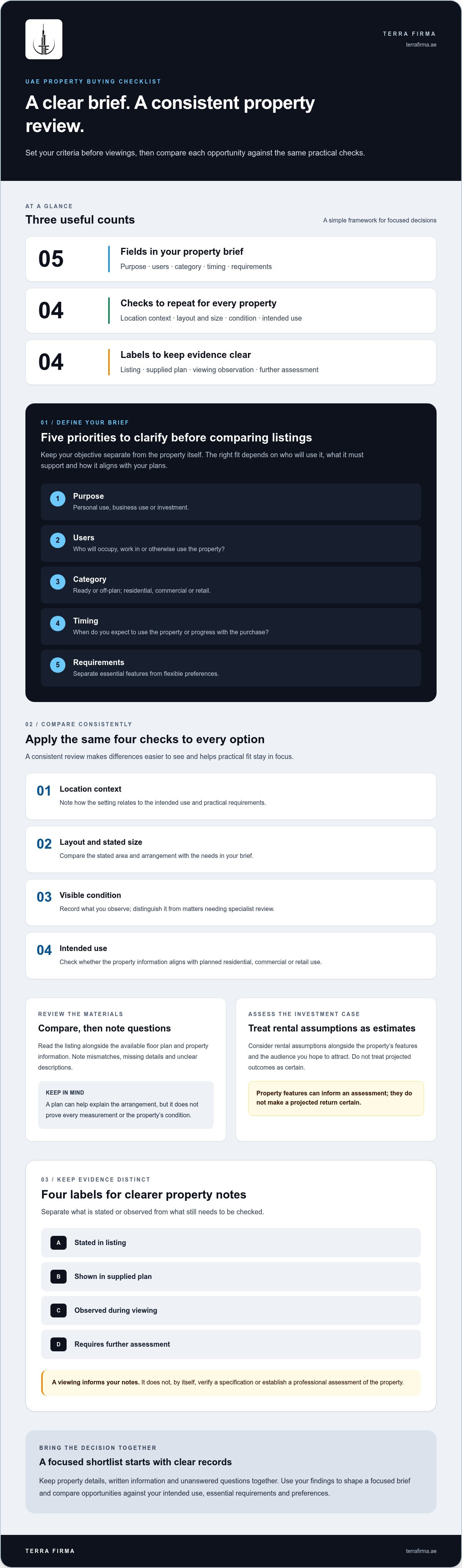
Before comparing listings, define the priorities that will guide each assessment. Start a working brief with your purpose, intended users, property category, timing, essential requirements and preferences. These criteria make it easier to decide which properties merit closer attention and which do not fit your plans.
Separate your objective from the property itself. A home for personal use, premises for business operations and an asset acquired for investment serve different purposes. The right fit depends on who will use the property, what it needs to support and how the purchase aligns with your wider plans.
A property brief is your decision framework, turning priorities into consistent criteria for assessing each opportunity.
- Purpose: personal use, business use or investment.
- Users: who will occupy, work in or otherwise use the property?
- Category: ready, off-plan, residential, commercial or retail.
- Timing: when do you expect to use the property or progress with the purchase?
- Requirements: which features are essential, and which are preferences?
Define your purpose, property type and priorities
Write essential requirements separately from flexible preferences. An office buyer might need a layout that supports the intended business activity, while a personal-use buyer may prioritise how the space accommodates its occupants. An investor can record the intended use and the property features relevant to the audience they hope to attract, while treating any projected outcome as an estimate rather than a certainty.
Be specific about users. Consider whether the property is for you, your family, employees, customers or future tenants. This distinction turns broad preferences into useful criteria, such as the type of space required, its functionality and any practical needs that should shape the search.
Set a realistic brief before building a shortlist
Record the property category that matches your purpose, then add timing and operational needs. A business buyer may need space suited to particular day-to-day activities; an end user may have a preferred move-in timeframe. Treat these as selection criteria, not assumptions about what is available. Keep the brief focused enough to guide your search while allowing room to consider suitable alternatives.
Use your UAE property buying checklist to capture these priorities before reviewing individual options. For a wider view of the purchase journey, refer to How to Buy Real Estate: A Considered UAE Guide for 2026. If regulatory context is relevant to your preparation, consult the background information on the Real Estate Regulatory Agency (RERA).
Before building a shortlist, check that you can explain the intended use in one sentence, distinguish essential requirements from preferences, and say who will use the property and when it needs to serve its purpose. Replace vague criteria such as “good layout” with a specific need, such as a configuration that accommodates the intended activity. A clear brief makes comparisons more consistent and keeps attention on properties aligned with your objectives.
Assess each UAE property against the same practical checklist
Once you have a shortlist, apply the same review to every property. Consistent criteria make differences easier to see and reduce the risk of allowing an attractive presentation to outweigh practical fit. A shortlist becomes more useful when every property is measured against the same clear criteria.
Compare location context, layout, stated size, visible condition and intended use. For example, assess whether an office layout appears suited to the business activity you have in mind, or whether a home’s arrangement fits its intended occupants. Record what you can observe separately from what remains an assumption. A viewing informs your notes, but it does not by itself verify a specification or establish a professional assessment of the property.
- Location context: note how the setting relates to your intended use and practical requirements.
- Layout and size: compare the stated area and arrangement with your needs.
- Condition: record visible observations and distinguish them from matters requiring specialist review.
- Use: check whether the property information aligns with your planned residential, commercial or retail use.
Review the property details and supporting information
Read each listing alongside the available floor plan and property information. Compare stated specifications with what the supporting material shows, and note any mismatch, missing detail or unclear description. A plan can help you understand the arrangement, but it is not proof of every measurement or the property’s condition. Keep a property-by-property record of questions so uncertainty remains visible rather than becoming an assumed fact.
Use clear labels in your notes: “stated in listing,” “shown in supplied plan,” “observed during viewing” and “requires further assessment.” This creates a useful record for later discussion. For transaction-related context, the UAE Ministry of Economy’s AML/CFT guidelines provide a reference on anti-money laundering and combating the financing of terrorism in the real estate sector. Consider such material in its proper context and seek appropriate professional guidance on specific requirements.
Consider ready and off-plan properties distinctly
For a ready property, focus on its present condition, actual layout and fit with immediate intended-use needs. Keep observed details separate from information that needs further assessment. For an off-plan property, review the project information, stated milestones and written purchase terms. Record what each document says, without assuming future delivery or features beyond the written material.
Keep the comparison balanced: a ready property can be assessed in its present state, while an off-plan opportunity calls for careful review of project and purchase documentation. In both cases, ask the same core questions: does the information support your intended use, what evidence is available, and what remains to be clarified?
A consistent review helps turn a broad selection into a considered shortlist. Terra Firma helps buyers identify and compare ready and off-plan properties against their requirements. Speak with Terra Firma about property selection.
Check the investment case without relying on promised returns
First distinguish the property’s intended role: rental income, business use or personal occupancy. These objectives call for different questions. A home chosen for personal use should meet the occupants’ needs; a commercial or retail asset must suit its intended activity; a rental investment should be assessed against a realistic view of its prospective audience. Keep these considerations separate so an appealing feature does not substitute for a sound fit.
Any rental estimate or performance projection is an assumption, not a guaranteed return or promise of future performance. Record what supports the figure, what remains uncertain and what you need to clarify. Do not fill information gaps with unsupported market averages.
| Assumption | Supporting information | Uncertainty | Follow-up question |
|---|---|---|---|
| Stated rental estimate | Source, date and stated basis | How the estimate was formed | What evidence supports it? |
| Intended tenant profile | Layout, size and property features | Whether the space suits that audience | Which features matter to the intended user? |
| Business or personal use | Requirements and planned occupancy | Any unassessed suitability factors | What needs further review? |
Review rental income assumptions with care
For each rental estimate, note who supplied it, when it was provided and what it assumes. Check whether the property’s layout and stated features align with the proposed tenant profile. An office intended for a particular business audience, for example, should be considered in light of its configuration and the user’s practical requirements, not just a headline income projection.
Mark missing details plainly. If the basis, period or supporting information for an estimate is unclear, record that as an open question rather than treating it as established. Apply the same discipline to every shortlisted property so that assumptions remain comparable.
Compare commercial, retail and residential use cases
Assess the space against the purpose you have in mind. For a commercial or retail property, separate operational suitability from investment considerations: a layout may suit a business, while the income assumptions still require scrutiny. For residential property, distinguish personal occupancy from rental use, since the intended user shapes the features that matter.
Keep projected income, resale prospects and occupancy in the category of estimates, not assured outcomes. Your UAE property buying checklist should make clear which points are supported by written information, which depend on assumptions and which need further assessment. This record gives you a grounded basis for comparing opportunities and deciding what to examine next.
Prepare your UAE property purchase questions before progressing
Before moving a property forward, gather your questions and the information that will help you assess the answers. Keep one record for each shortlisted option, so property-specific details do not become mixed with general questions about the purchase process. A clear record also makes it easier to see what is documented, what remains uncertain and what needs professional input.
A documented purchase question identifies what needs clarification; an unverified assumption treats an uncertain detail as fact.
- Consolidate questions. Bring together your notes, property details and outstanding points.
- Review written information. Check the material available for the specific property and note its date.
- Clarify terms. Identify wording or details you need explained before deciding.
- Choose next steps. Proceed, seek advice or pause while a material question remains open.
Organise information and questions for each shortlisted property
Create a separate comparison record for each option. Include its stated details, the written information received, any assumptions you are considering and the questions still to resolve. If dates, terms or specifications may change, use current written information rather than relying on an earlier conversation. Keep property-specific queries, such as a stated feature or term, separate from broader questions about the purchase process.
- What written information supports this property detail?
- Is the document current for the decision being considered?
- Which terms or specifications need further explanation?
Know when to bring in transaction advice
Legal, tax, mortgage and regulatory questions can depend on your circumstances and the transaction. Direct those matters to suitably qualified professionals. Transaction advice can help organise property information, coordinate questions and keep the decision process clear, while specialist advice addresses matters within the professional’s remit. Advisory support should not be treated as a guarantee of approval, property value or investment performance.
Use your UAE property buying checklist to distinguish confirmed written information from estimates and unresolved points. Before progressing, give each key question a clear status: answered by the material, awaiting clarification or referred for professional advice. This gives you a practical basis for deciding what to do next without mistaking an incomplete answer for certainty.
Terra Firma supports buyers with property selection and end-to-end sales transaction coordination, helping organise information around their priorities. Contact Terra Firma for current availability, pricing, floor plans and a private consultation to discuss the properties under consideration and the next steps in your purchase.
Move from your UAE property checklist to a considered next step
A completed UAE property buying checklist should leave you with four useful tools: a focused brief, a relevant shortlist, an evidence review and a clear record of open questions. Together, they turn a broad search into a considered next step. Keep confirmed property information distinct from investment assumptions, and make unresolved points visible rather than allowing them to disappear into the process.
Turn the checklist into a focused property brief
Summarise the intended use, property category, essential requirements and unanswered questions. Note whether you are considering a ready or off-plan property, residential space, commercial premises or retail. Then separate written property details from estimates or expectations. A rental assumption, for example, belongs in the brief as an assumption, not as a confirmed feature of the property.
Use this brief to guide a relevant shortlist. If a property does not align with a central requirement, record why; if it could still work with a compromise, state what that compromise is. This makes comparisons more deliberate and helps prevent browsing from expanding without adding meaningful options.
- Purpose: what the property needs to support.
- Requirements: which features are essential and which are flexible.
- Evidence: what written information supports your assessment.
- Open questions: what needs clarification before you proceed.
Explore suitable properties with Terra Firma
Share your brief, preferred property category, shortlist and outstanding questions with Terra Firma. This gives the discussion a practical starting point: property selection can focus on your intended use and investment priorities, while transaction coordination helps keep relevant information and next steps organised. Terra Firma advises buyers on ready and off-plan properties, including commercial and retail assets, across the UAE.
Terra Firma’s property sales and acquisition support helps bring structure to the selection process. Assess each property on the available information, your requirements and any professional advice relevant to your circumstances, rather than treating a property or projection as a guaranteed outcome.
Take the next step with a clear brief and a focused discussion. Contact Terra Firma for current availability, pricing, floor plans and a private consultation.
Take your next property decision forward with clarity
A considered purchase is not defined by how quickly you choose, but by how well the property continues to fit your purpose as details become clearer. Use your UAE property buying checklist as a reference point during the next conversation, keeping the decision anchored to your priorities rather than to presentation alone.
Bring your brief and the property questions that matter most into a focused discussion. That gives the conversation a clear starting point and helps keep next steps relevant to your intended use, whether you are considering a home, business premises or an investment. A measured approach leaves room to assess new information without losing sight of what makes an option suitable for you.
Terra Firma Real Estate LLC supports buyers through property selection and purchase discussions. Discuss your requirements and request current availability, pricing, floor plans and a private consultation. With a clear direction, you can approach your next decision with greater confidence.
Frequently Asked Questions
Can I use one UAE property buying checklist for residential and commercial property?
Yes. Keep a shared framework for purpose, property information and decision questions, then tailor the assessment to the asset. For a residence, consider how the rooms serve the intended occupants. For an office or retail space, examine whether the configuration supports the planned business activity. A UAE property buying checklist works best when it combines consistent comparison points with criteria specific to each property’s intended use.
Is a ready property or an off-plan property better for a buyer?
Neither is automatically better; the right choice depends on your plans and what can be assessed at the time of purchase. A ready property lets you consider its present condition and layout. An off-plan purchase calls for close attention to written project information and purchase terms. Compare each option against your intended timing, use and requirements, and treat future features or outcomes as subject to the relevant documentation.
What should I check before paying a property booking amount in the UAE?
Before paying, identify the property and transaction the amount relates to, the recipient, the payment method and the written terms that explain how the amount is treated. Read any reservation or booking document carefully, including provisions on timing, cancellation and whether the amount is refundable. Keep copies of the paperwork and payment record. If a term is unclear or consequential, obtain suitable professional advice before committing funds.
How can I assess rental income estimates for a UAE property?
Ask what the estimate represents and what information supports it. Check whether it refers to gross or net income, the assumed rental period and the type of occupant it anticipates. For example, consider whether an office’s configuration fits the proposed business tenant, rather than judging the estimate in isolation. Compare estimates only when their assumptions are similar, and leave unsupported figures out of your decision rather than substituting a general market average.
Do I need professional advice when buying property in the UAE?
Professional advice is valuable when a decision involves legal, tax, mortgage or regulatory questions, or when written terms are unclear. Seek guidance from a suitably qualified professional for matters within their area of expertise. A real estate adviser can help organise property information and coordinate transaction steps, but that support does not replace specialist advice or guarantee approval, value or investment performance. Keep advice and property documentation together for reference.
How can I keep my UAE property buying checklist current?
Update it whenever you receive revised written information, view a property or clarify an important term. Add the date and source beside changing details, and retain earlier versions so you can see what changed. If availability, specifications or purchase terms are updated, revisit any comparison or assumption affected by that change. A current record helps prevent decisions from relying on outdated details and keeps your next questions focused on the property under consideration.


